 LEWOS BIOTECHNOLOGYNEUROSCIENCE · PRECLINICAL CROExplore · Discover · Advance

PD · Parkinson’s disease
Parkinson's disease
Parkinsonian pathology combines α-syn aggregation with progressive loss of TH+ dopaminergic neurons and motor coordination. Model choice and observation window should reflect the rate and mechanism of progression.
A53T supports longitudinal assessment of α-syn pathology and progressive motor change. MPTP rapidly induces dopaminergic injury and supports short treatment studies. Both can be validated by sex.
PD studies can combine beam walk, pole, wire hang, rotarod, grip and fine behavior with TH immunofluorescence, α-syn markers and pharmacologically or genetically defined models.
- 6Available PD models
- 6Motor dimensions
- 7+Molecular markers
- ≥75%Model success rate
Model strategy
α-syn, TH+ neurons and motor-function assessment.
Match the model and study conditions to candidate mechanism, intervention stage and target tissue.
A53T
α-syn pathology and progressive motor deficit
MPTP
Dopaminergic injury and motor phenotype
Thy1-SNCA
α-syn expression and synaptic function
LRRK2-G2019S
LRRK2-related mechanisms
PFFs
α-syn aggregation research
6-OHDA
Unilateral injury and asymmetric motor behavior
Evaluation endpoints
- 01TH+ neurons and α-syn quantification
- 02Beam walk, pole, rotarod and open field
- 03DA / DOPAC / HVA
- 04Striatal electrophysiology and molecular endpoints
Representative data
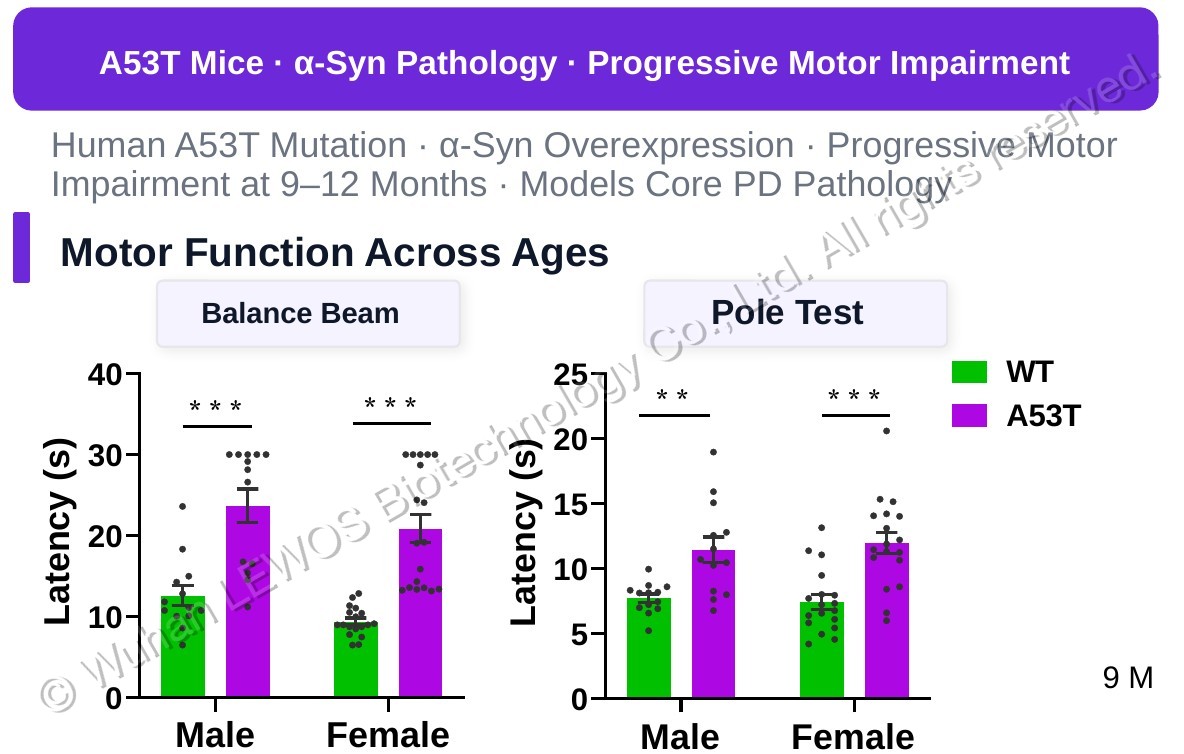
A53T mice · α-syn pathology · Progressive motor impairment
Beam walk and pole test in human mutant A53T transgenic mice (α-syn overexpression, 9 months of age, ♂/♀) versus WT controls; traversal/latency time is significantly prolonged in the A53T group, modeling the core pathology and progressive motor deficits of clinical PD.
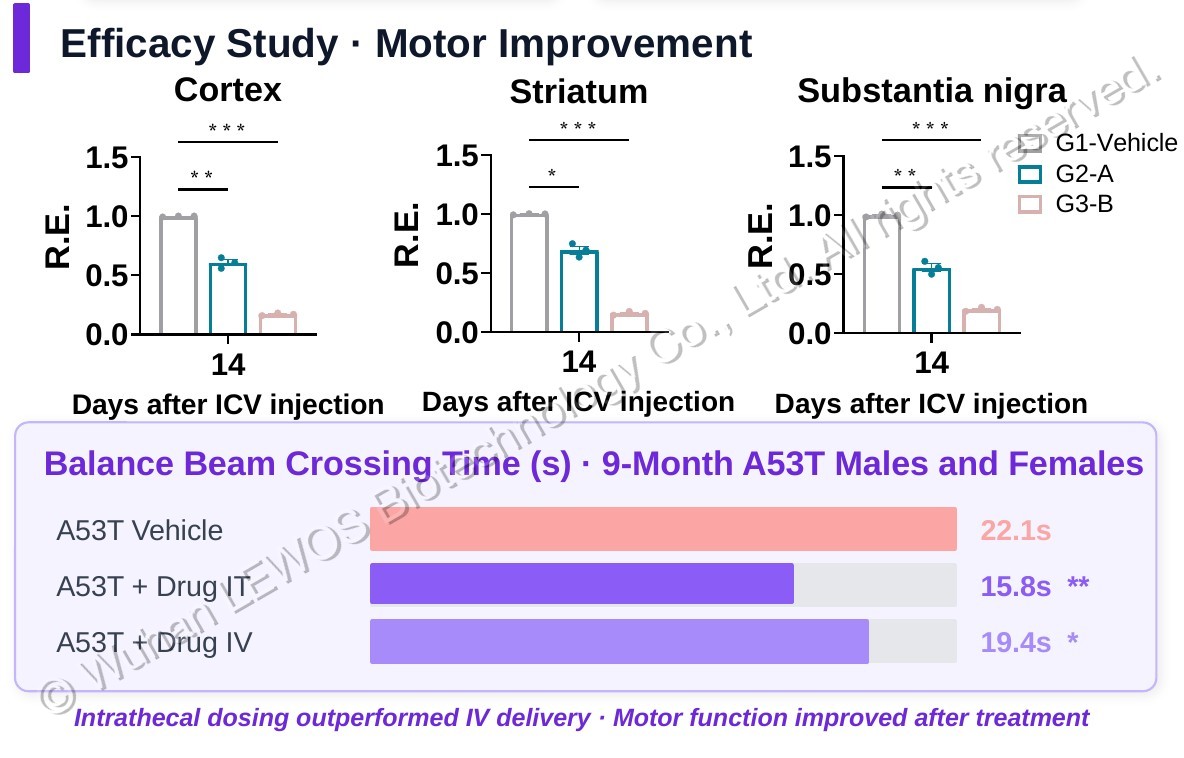
Efficacy validation · Test article improves target gene expression and motor function in mice
Relative target gene expression in the Cortex, Striatum and Substantia nigra of A53T mice 14 days after ICV administration (G1-Vehicle / G2-A / G3-B groups) and beam walk traversal time in 9-month-old A53T mice (A53T Vehicle / A53T+Drug IT / A53T+Drug IV); the recovery effect of IT administration was superior to IV.
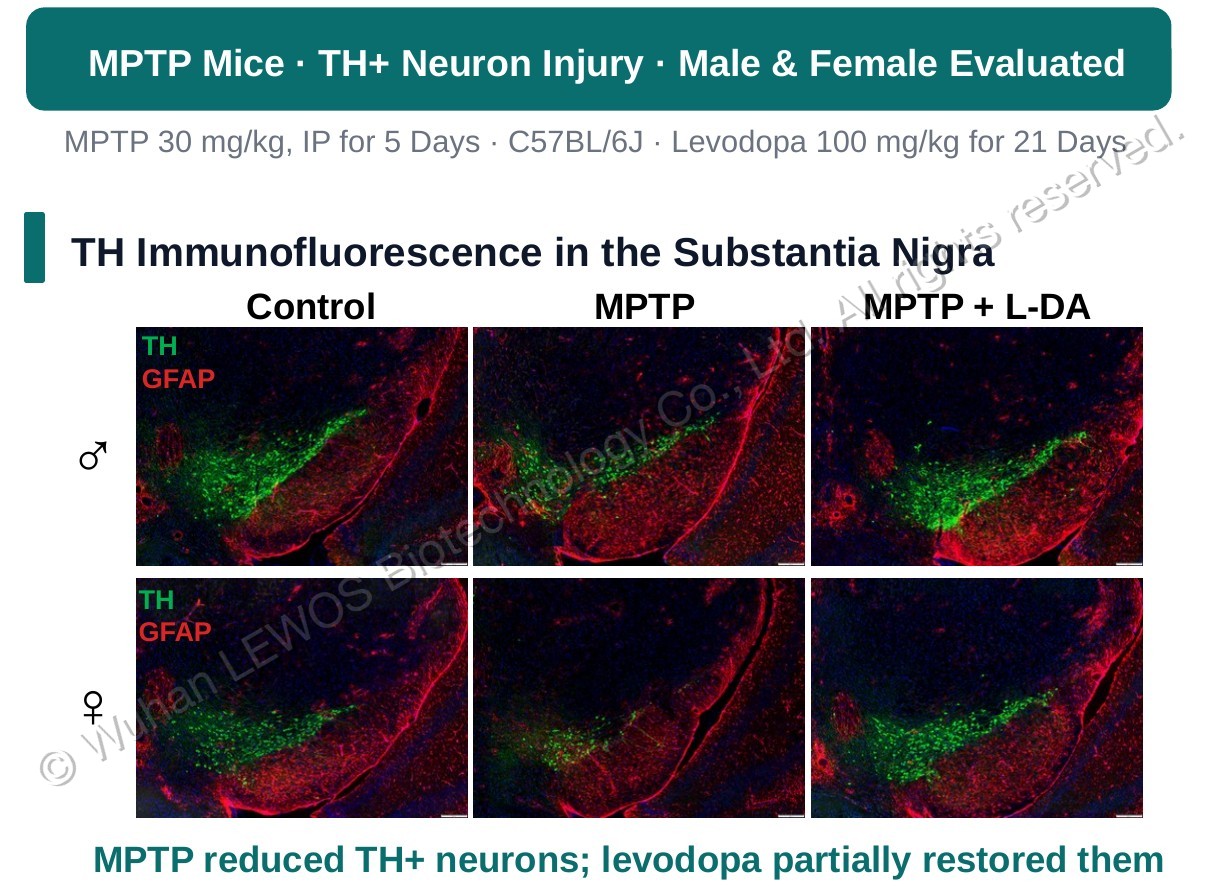
MPTP mice · TH+ neuronal injury · Validation in male and female
TH/GFAP immunofluorescence staining of the substantia nigra in the midbrain of MPTP-lesioned C57BL/6J mice (30mg/kg intraperitoneal injection for 5 days, 100mg/kg levodopa treatment for 21 days), comparing Control, MPTP and MPTP+L-DA groups in ♂/♀; TH+ neurons were significantly reduced after modeling and partially recovered after levodopa treatment.
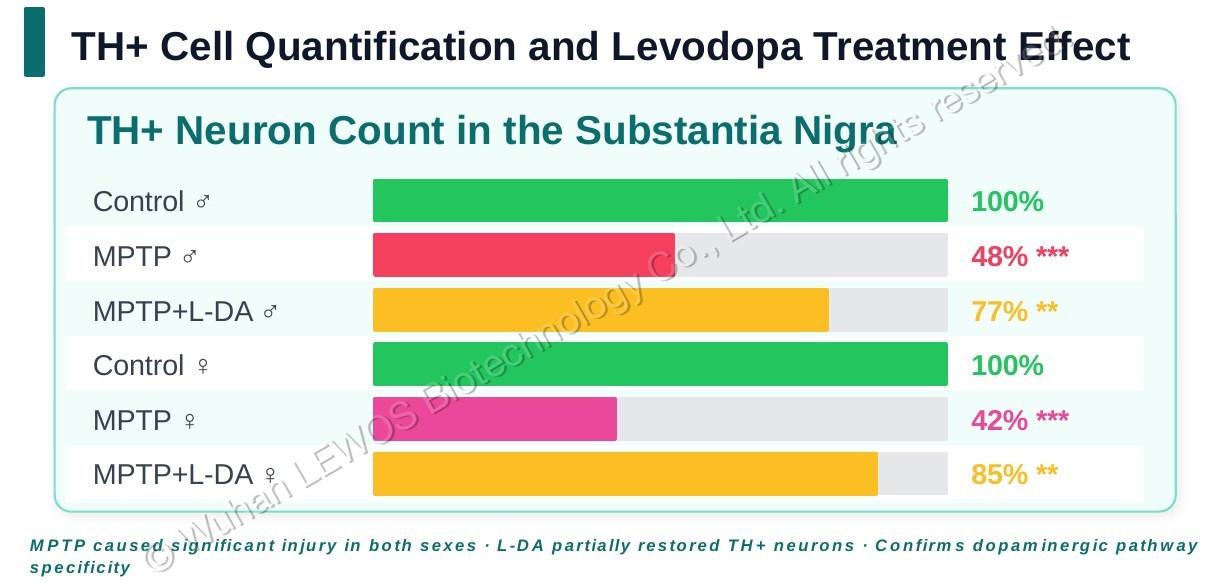
TH+ cell quantification & levodopa treatment effect
TH+ neuron counts in the substantia nigra of the midbrain (Control, MPTP and MPTP+L-DA groups in both ♂/♀, with Control set as 100%); MPTP caused significant injury in both sexes and L-DA produced partial recovery, validating the specificity of the model for the dopaminergic pathway.
Technical contact
Discuss your target, model or delivery question and learn about study plans, project scope and pricing.