

hTFR macromolecule brain delivery
- hTFR humanized mouse
- hTFR × 5xFAD
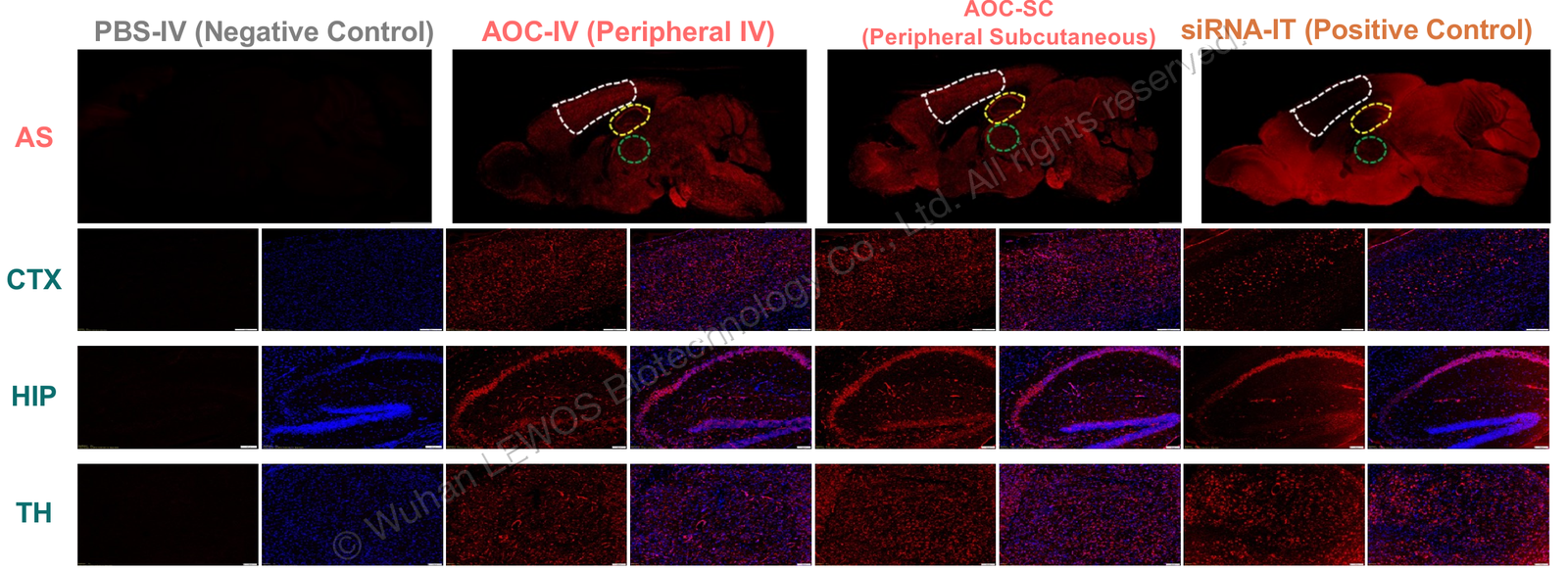
- Distribution across cortex, hippocampus and thalamus
- Peripheral-tissue comparison
- qPCR target-gene quantification
- ELISA protein-effect assay
LEWOS BIOTECHNOLOGYNEUROSCIENCE · PRECLINICAL CROExplore · Discover · AdvancehTFR · BBB DELIVERY
Use hTFR humanized mice to connect peripheral dosing, brain distribution and target engagement for TfR1-targeted macromolecules.
Macromolecules do not readily cross the blood-brain barrier. TfR1-mediated transport is a major delivery strategy, but brain distribution varies by format, route and dose and should be measured directly. Our hTFR platform connects peripheral dosing, brain imaging and multi-region qPCR quantification.
For comparing TfR1-targeted macromolecule delivery and, where needed, linking it to disease-model efficacy.
When in vitro binding is complete and peripheral-to-CNS delivery needs confirmation; when formats or routes must be compared; or when established delivery needs to connect with disease efficacy.
01How is the candidate distributed across brain regions after peripheral dosing?
02How do dosing routes change target engagement?
03Can delivery performance connect to efficacy in an indication-specific model?
Choose an experiment combination around the research question. Steps, groups and timing are confirmed per project.
Align format, dose, route and observation time.
Assess cortex, hippocampus, thalamus and peripheral tissues.
Measure target-gene or protein changes with qPCR and ELISA.
Select an indication-specific model for continued efficacy testing.
See how models map to endpoints, then open the topic page for model scope and representative evidence.
Delivery evaluation is indication-agnostic. hTFR × 5xFAD is one established composite-model example, not a restriction of this service.
DELIVERABLES
Deliverables are confirmed against the actual study scope and experiment combination.
Open the topics most directly related to this service for model scope and representative data.
Tell us your candidate type, study goal and development stage. We will help identify the experiment combination for hTFR macromolecule brain delivery.