 LEWOS BIOTECHNOLOGYNEUROSCIENCE · PRECLINICAL CROExplore · Discover · Advance

hTFR · BBB delivery
hTFR macromolecule brain delivery
Macromolecules do not readily cross the blood-brain barrier. TfR1-mediated transport can improve delivery, but distribution must be measured directly across formats, routes and doses.
hTFR mice humanize the key human TfR1 binding domain and support IV or SC evaluation of AOCs, bispecifics, ADCs and other macromolecules, with route controls in the same study.
The platform connects dosing, brain-distribution imaging, multi-region qPCR and target engagement, with optional composite disease models.
- 8+Brain regions
- IV · SCPeripheral routes
- Full chainDosing → distribution → qPCR → efficacy
Model strategy
Connect TfR1-targeted antibody and protein delivery with brain-region distribution and target engagement.
Match the model and study conditions to candidate mechanism, intervention stage and target tissue.
hTFR humanized mouse
Distribution and effect after IV / SC dosing
hTFR × 5xFAD
Delivery effect linked to AD efficacy
Evaluation endpoints
- 01Distribution across cortex, hippocampus and thalamus
- 02Peripheral-tissue comparison
- 03qPCR target-gene quantification
- 04ELISA protein-effect assay
Representative data
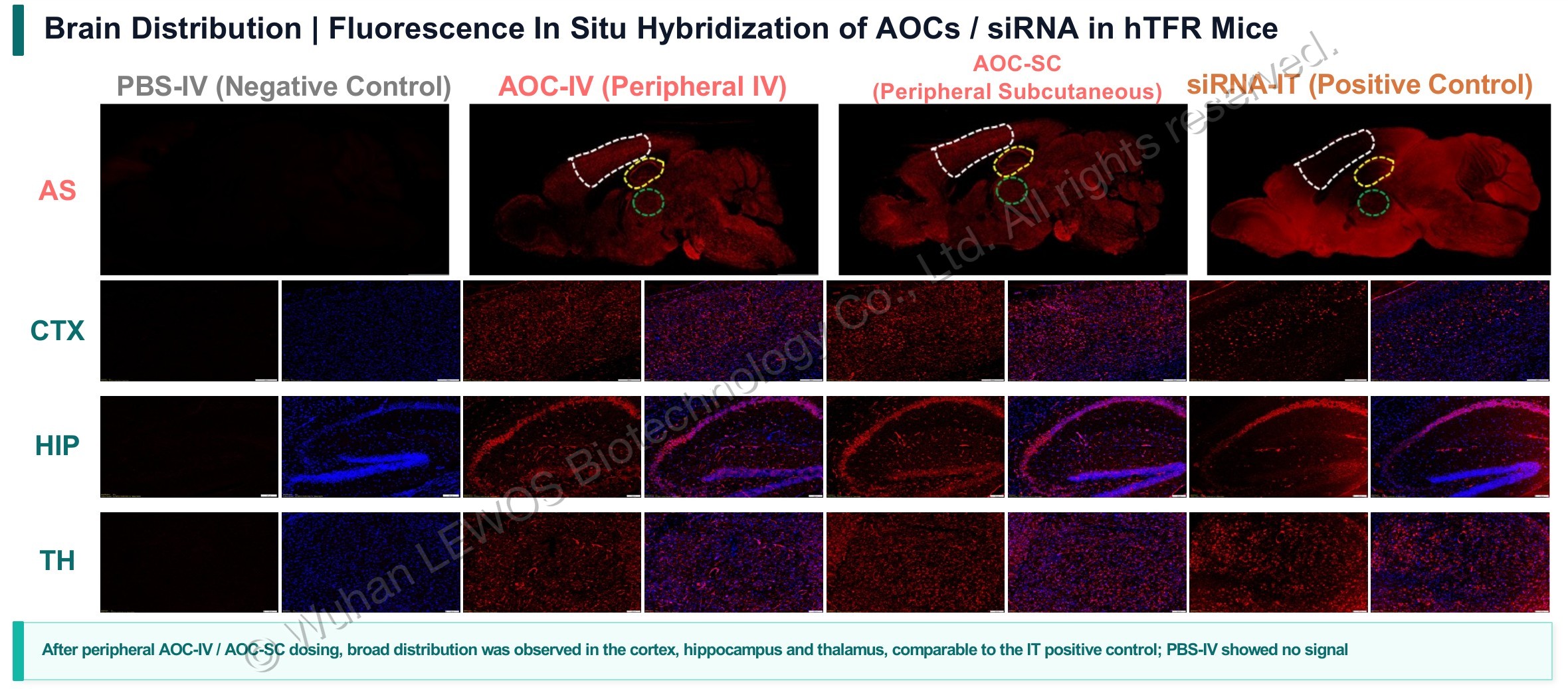
Brain distribution map | Fluorescence in situ hybridization distribution of AOC / siRNA in hTFR mice
After peripheral administration of AOC-IV and AOC-SC, fluorescence in situ hybridization in four brain regions (AS, CTX, HIP, TH) of hTFR humanized mice showed broad AOC/siRNA distribution, with an effect comparable to the siRNA-IT intrathecal positive control, while the PBS-IV negative control showed no signal.
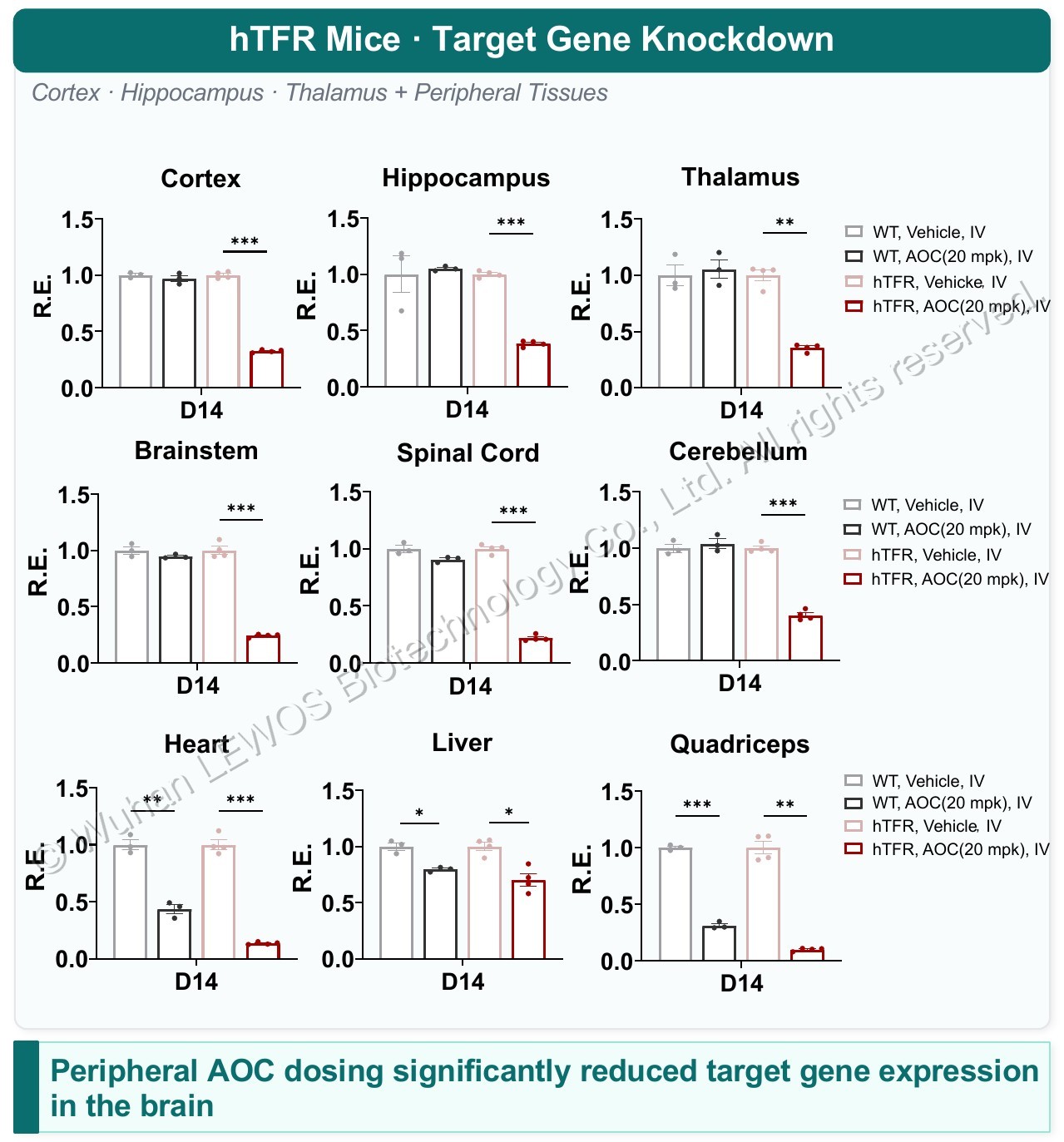
hTFR mice · Target gene knockdown
After intravenous AOC administration in hTFR humanized mice, relative target gene mRNA expression (RT-qPCR, D14) in the cortex, hippocampus, thalamus, brainstem, spinal cord and cerebellum as well as heart, liver and quadriceps was significantly reduced compared with the WT Vehicle and hTFR Vehicle controls.
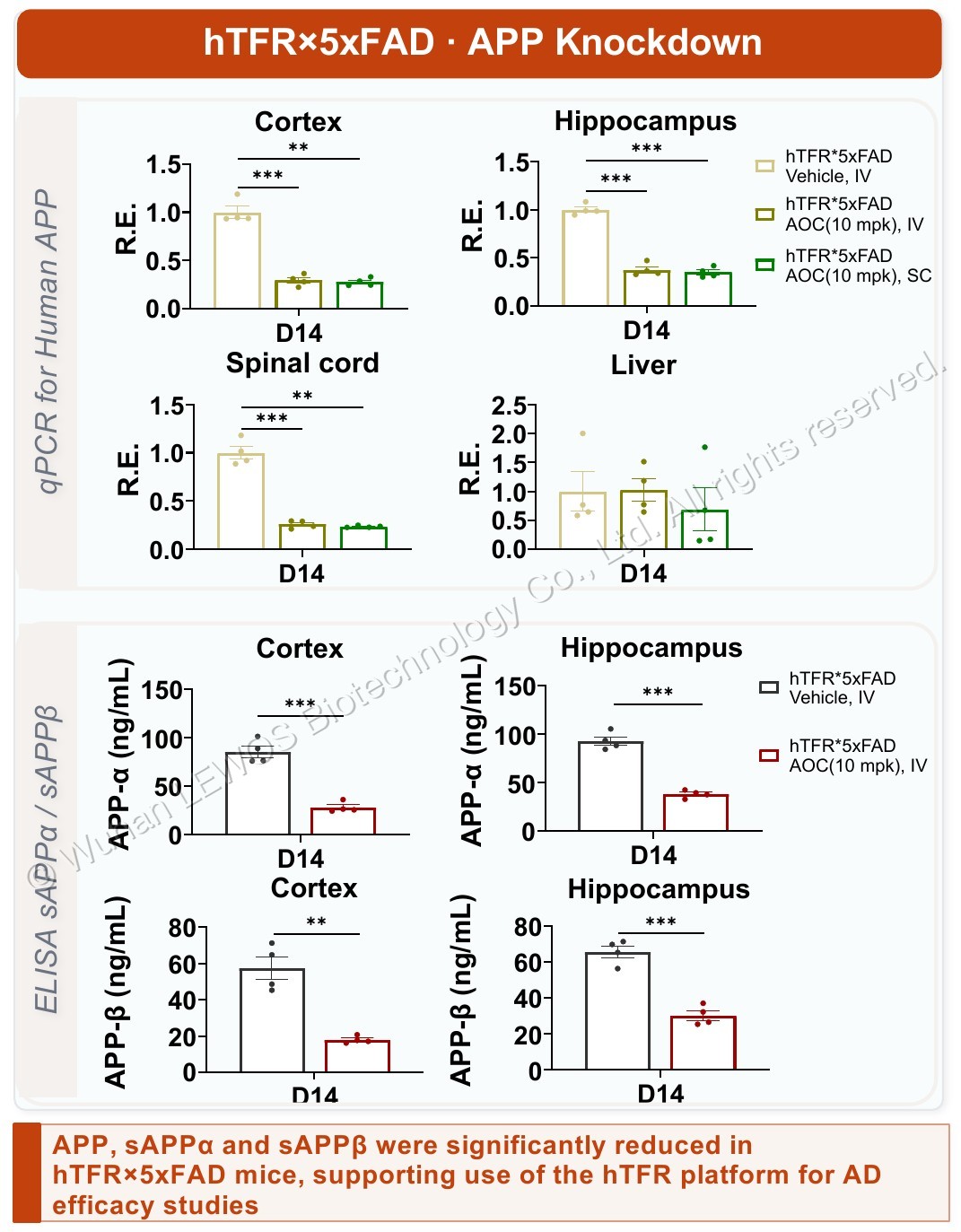
hTFR×5xFAD · APP target gene knockdown
RT-qPCR (cortex, hippocampus, spinal cord, liver) and ELISA (cortex, hippocampus, DRG, liver sAPPα/sAPPβ) results for APP target gene knockdown in hTFR×5xFAD double-transgenic AD model mice; the AOC 20 mpk and AOC10 mpk dosing groups showed significant reductions at D14 compared with the Vehicle control.
Technical contact
Discuss your target, model or delivery question and learn about study plans, project scope and pricing.